Accreditation Certificate
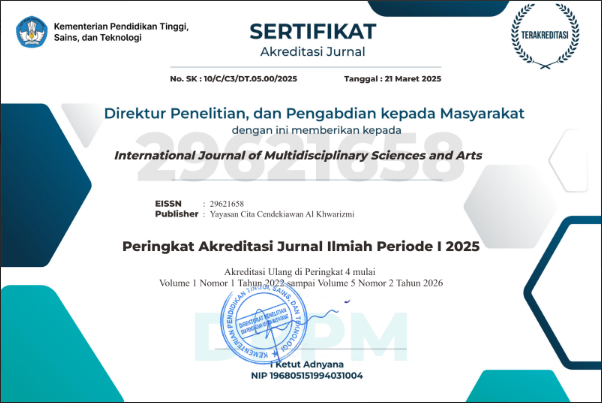
E-ISSN:

Template Journal:

INDEXING :






COUNTER:


The International Journal of Multidisciplinary Sciences and Arts (IJMDSA) supports open, constructive, transparent, and evidence-based scholarly discussion of published research across its multidisciplinary areas of interest.
The journal recognizes that independent verification, replication studies, methodological reassessment, comparative analysis, critical interpretation, and subsequent scholarly developments may generate findings that support, refine, or challenge previously published conclusions.
Post-publication discussions are managed in accordance with the principles of the Committee on Publication Ethics (COPE), editorial independence, research integrity, fairness, and transparency.
The purpose of this policy is to facilitate responsible academic dialogue, strengthen the reliability of published research, and provide appropriate mechanisms for addressing scientific questions and concerns arising after publication.
Post-publication discussions may address any scholarly work published in IJMDSA, provided that the discussion is relevant to the journal's scope and supported by scientific reasoning, appropriate references, or verifiable evidence.
Discussions may cover research methodology, theoretical frameworks, literature reviews, data collection, sampling procedures, experimental design, statistical analysis, interpretation of findings, ethical considerations, and the consistency of conclusions with the available evidence.
Depending on the relevant discipline, discussions may address, but are not limited to, the following areas:
All post-publication contributions must demonstrate scholarly relevance, maintain professional standards, and distinguish verifiable findings from opinions or interpretations.
Researchers, academics, practitioners, students, and other interested parties may submit comments, critiques, methodological clarifications, replication findings, or other scholarly contributions concerning articles previously published in IJMDSA.
Submissions should be sent to the journal's editorial office at:
Editorial Contact: publikasi@itscience.org
Each submission should clearly identify the original article, including its title, authors, publication details, and DOI or article URL where available.
The submission should provide a concise explanation of the issue being raised, the scientific or scholarly basis for the concern, and relevant supporting evidence.
Supporting materials may include research data that may lawfully be shared, analytical procedures, methodological documentation, source code where relevant, scholarly references, or other materials necessary to substantiate the discussion.
Authors submitting comments or critiques must maintain a professional tone, avoid personal attacks, respect intellectual property rights, and comply with applicable ethical and legal requirements.
The Editor-in-Chief or a designated editor will conduct an initial assessment of each submission to determine its relevance to IJMDSA, scholarly merit, clarity, and adequacy of supporting evidence.
Submissions may be assessed according to their methodological soundness, originality, significance, fairness, and potential contribution to understanding or evaluating the original publication.
Where appropriate, the journal may invite independent reviewers with expertise in the relevant discipline or research methodology.
Because IJMDSA covers multiple academic fields, reviewers should possess expertise appropriate to the subject matter of the original article and the concerns raised.
Editors and reviewers must disclose relevant conflicts of interest and withdraw from the evaluation process when their impartiality could reasonably be questioned.
The journal may decline submissions that fall outside its scope, lack sufficient scholarly justification, repeat previously addressed concerns without new evidence, or contain unsupported allegations or inappropriate personal commentary.
Authors whose published work is the subject of a substantive post-publication discussion will normally be given a reasonable opportunity to respond.
The journal may invite the original authors to provide clarifications, additional analyses, methodological explanations, supporting references, or other relevant evidence.
Depending on the subject of the discussion, responses may address research design, theoretical assumptions, data interpretation, analytical procedures, limitations, ethical considerations, or alternative explanations for the reported findings.
Where appropriate and feasible, authors may provide additional documentation, research materials, datasets, or analytical procedures to support the evaluation of their work, subject to legal, ethical, licensing, privacy, confidentiality, and information security restrictions.
The opportunity to respond does not imply that the original authors must agree with the critique. Their response should, however, address the substantive scholarly issues raised.
The editorial team will evaluate the critique and the author's response objectively, considering the available evidence and the relevant disciplinary standards.
Submissions that meet the journal's editorial and scholarly standards may be published as Letters to the Editor, scholarly commentaries, critical reviews, author responses, replication reports, or other appropriate forms of academic communication.
The format of publication will depend on the nature, significance, and scope of the contribution.
Where technically feasible, published discussions and author responses will be linked to the original article to facilitate transparent scholarly communication and enable readers to understand the issues and responses in context.
Publication of a commentary or critique does not necessarily indicate that the journal endorses every conclusion expressed by its author.
Similarly, publication of an author response does not automatically resolve the concerns raised. Readers should evaluate the discussion in light of the evidence and arguments presented.
All published contributions remain subject to the journal's applicable editorial standards, publication ethics requirements, and correction procedures.
IJMDSA encourages methodological transparency and the disclosure of sufficient information to enable readers and qualified researchers to evaluate published findings.
Depending on the discipline, relevant information may include research protocols, sampling procedures, survey instruments, analytical methods, statistical procedures, software versions, experimental configurations, data collection methods, theoretical assumptions, and other materials necessary to assess the reliability of the research.
Authors are encouraged to provide access to supporting research materials when appropriate and lawful, subject to applicable ethical, legal, institutional, privacy, confidentiality, and intellectual property requirements.
The journal recognizes that independent replication may produce findings that differ from those originally reported. Such differences should be assessed in relation to the comparability of methods, samples, research settings, assumptions, and analytical procedures before conclusions about research reliability are drawn.
An unsuccessful replication does not, by itself, establish that the original research is unreliable or that misconduct has occurred.
Authors are not required to disclose confidential information, protected personal data, restricted research materials, security credentials, or other information whose disclosure would violate applicable obligations or create disproportionate risks.
When post-publication discussions raise credible concerns about potential research or publication misconduct, the matter will be assessed in accordance with the journal's applicable research and publication ethics policies.
Concerns may include plagiarism, data fabrication, data falsification, manipulated images, inappropriate data manipulation, undisclosed conflicts of interest, unauthorized use of research materials, unethical research practices, or other serious violations of scholarly integrity.
All allegations must be assessed carefully and impartially using relevant documentation, verifiable evidence, and appropriate opportunities for the individuals concerned to respond.
Allegations must not be treated as established findings before an appropriate assessment has been completed.
Where necessary, the journal may seek clarification from the authors, consult independent experts, or contact relevant research institutions or other responsible organizations in accordance with applicable ethical and legal requirements.
The journal will respect confidentiality and procedural fairness to the extent reasonably possible while addressing concerns about the integrity of the scholarly record.
When post-publication discussions identify material errors, unresolved concerns, or evidence that may affect the reliability or integrity of a published article, IJMDSA may consider appropriate editorial action.
Depending on the nature and seriousness of the issue, possible actions include:
Editorial decisions will be proportionate to the seriousness of the issue, the strength of the available evidence, and the potential implications for the scholarly record.
Where feasible, corrections, Expressions of Concern, and retraction notices will be linked to the original publication, clearly identified, and accompanied by an explanation of the editorial action.
The journal will seek to ensure that the scholarly record remains transparent and that readers can distinguish between the original publication and subsequent editorial notices.
All authors, editors, reviewers, and other individuals involved in the assessment of post-publication submissions must disclose relevant actual, potential, or perceived conflicts of interest.
Conflicts may arise from personal relationships, institutional affiliations, financial interests, professional competition, collaborative relationships, or other circumstances that could influence the impartial assessment of a submission.
The journal will take reasonable steps to manage disclosed conflicts, including assigning an independent editor or reviewer where appropriate.
Editorial decisions must be based on scholarly merit, relevance, evidence, research integrity, and the journal's established policies.
No decision should be influenced by personal disagreements, institutional status, commercial interests, academic rivalry, or pressure intended to suppress legitimate scholarly criticism.
IJMDSA is committed to treating authors, commentators, reviewers, and other contributors fairly and respectfully throughout the post-publication discussion process.
The journal will protect confidential communications, unpublished materials, personal information, and other sensitive information to the extent reasonably possible and consistent with applicable ethical, legal, and editorial requirements.
Participants must not disclose confidential editorial correspondence, unpublished reviewer comments, or restricted research materials without appropriate authorization.
The journal does not tolerate intimidation, harassment, discriminatory conduct, personal attacks, or knowingly unsupported accusations in scholarly discussions.
Criticism must focus on the research, its methodology, its evidence, or its interpretation rather than on the personal characteristics or professional standing of the individuals involved.
The editorial office will maintain appropriate records of post-publication submissions, supporting evidence, correspondence, author responses, reviews, and editorial decisions.
These records will be handled in accordance with applicable confidentiality, privacy, data protection, and record-management requirements.
Individuals who believe that an editorial decision involved a material factual error, procedural irregularity, or failure to consider relevant evidence may submit a reasoned appeal to publikasi@itscience.org.
Appeals should identify the decision being challenged, explain the specific grounds for the appeal, and provide relevant supporting documentation.
Where feasible, an appeal will be reviewed by an editor or independent party who was not directly involved in the original decision.
The journal will consider appeals objectively and communicate its decision through the appropriate editorial channels. An appeal does not guarantee a change in the original decision.
IJMDSA recognizes post-publication discussion as an important component of continuing scholarly evaluation and the development of knowledge across disciplines.
Through this policy, the journal seeks to encourage constructive academic debate, support independent verification and methodological transparency, facilitate the correction of published errors, and strengthen confidence in the integrity of the scholarly record.
The journal welcomes evidence-based contributions that advance understanding, challenge assumptions responsibly, clarify interpretations, and promote improvements in research practice.
By applying this policy consistently and fairly, IJMDSA aims to maintain an environment in which scholarly disagreement can contribute positively to scientific progress, intellectual exchange, and the responsible dissemination of knowledge across its multidisciplinary fields.
Accreditation Certificate
E-ISSN:
Template Journal:
INDEXING :
COUNTER:
Acceptance Rate: 70.8%


|
info@itscience.org, web: https://itscience.org |
International Journal of Multidisciplinary Sciences and Arts is licensed under a Creative Commons Attribution-NonCommercial 4.0 International (CC BY-NC 4.0). |
|---|


