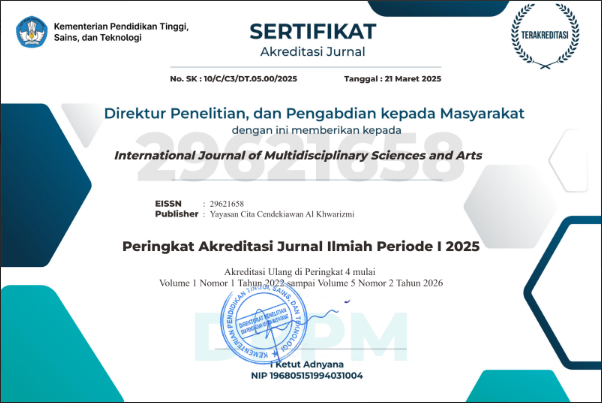
Accreditation Certificate
E-ISSN:

Template Journal:

INDEXING :






COUNTER:


The International Journal of Multidisciplinary Sciences and Arts (IJMDSA) is committed to maintaining academic honesty, research integrity, methodological transparency, data integrity, and ethical standards throughout the research, peer-review, and publication processes.
All allegations of research and publication misconduct will be assessed fairly, objectively, proportionately, and on the basis of available evidence, in accordance with relevant guidance and principles of the Committee on Publication Ethics (COPE).
Research and publication misconduct refers to conduct that violates accepted standards of academic honesty, originality, research ethics, transparency, or scholarly responsibility.
Potential forms of misconduct include, but are not limited to, the following:
Plagiarism: Presenting another person's text, ideas, theories, data, images, creative works, or research findings without appropriate acknowledgment.
Data Fabrication: Inventing research data, observations, experimental results, survey responses, interview records, or other findings that were never obtained or generated.
Data Falsification: Manipulating, selectively altering, or omitting research data, images, observations, or results in a manner that misrepresents the research findings.
Research Methodology and Analytical Misconduct: Deliberately misrepresenting research methods, sampling procedures, analytical techniques, statistical analyses, validation processes, or other methodological elements in a way that materially misleads readers.
Duplicate or Redundant Publication: Republishing substantially overlapping research without appropriate disclosure, justification, or acknowledgment, contrary to accepted publication standards.
Authorship Misconduct: Inappropriately including or excluding contributors, misrepresenting author contributions, or falsely claiming authorship or approval of a manuscript.
Peer-Review Manipulation: Fabricating reviewer identities, creating fraudulent reviewer accounts, improperly influencing reviewers, or otherwise compromising the integrity of the peer-review process.
Research Ethics Violations: Conducting research involving human participants, animals, personal information, or other ethically sensitive materials without required ethical approval, informed consent, authorization, or safeguards, where applicable.
Data Protection and Confidentiality Violations: Using, disclosing, or distributing personal data, confidential information, restricted datasets, or research materials without appropriate authorization or a lawful basis.
Copyright and Licensing Violations: Using text, images, software, datasets, or other protected materials in violation of applicable copyright, licensing, attribution, or permission requirements.
Undisclosed Conflicts of Interest: Failing to disclose relevant financial, professional, personal, or institutional interests that could improperly influence research or publication decisions.
Misrepresentation of Research Findings: Knowingly making materially misleading statements about research procedures, originality, results, limitations, sources, or conclusions.
Unintentional errors, legitimate scholarly disagreements, differences in interpretation, and unsuccessful replication attempts do not automatically constitute research misconduct. A determination of misconduct requires appropriate examination of the available evidence and relevant circumstances.
Authors, reviewers, editors, readers, researchers, institutions, and other interested parties may report suspected research or publication misconduct involving manuscripts submitted to IJMDSA or articles already published in the journal.
Reports should be directed to the journal's editorial office or research integrity contact:
Email: publikasi@itscience.org
Reports should identify the relevant manuscript or published article, describe the alleged misconduct clearly, and provide supporting evidence whenever available.
Supporting evidence may include textual similarities, inconsistent research records, discrepancies in datasets, questionable images, statistical irregularities, ethical approval concerns, replication findings, or other verifiable documentation.
IJMDSA will consider reports submitted in good faith regardless of the reporter's academic position, institutional affiliation, or professional status.
Reports should distinguish documented evidence from assumptions, interpretations, and unresolved suspicions. The journal does not treat an allegation as proof of misconduct.
The Editor-in-Chief or a designated editor will conduct a preliminary assessment to determine whether the allegation falls within the journal's responsibilities and whether sufficient information exists to justify further examination.
The assessment may include reviewing the submitted evidence, examining the relevant manuscript or article, conducting similarity screening, evaluating research methods, checking data consistency, reviewing statistical analyses, or consulting relevant subject-matter experts.
Assessment procedures will depend on the nature of the allegation and the discipline concerned.
For science and technology research, the assessment may examine experimental procedures, computational methods, technical configurations, analytical processes, and reported results.
For social and management sciences, it may examine sampling procedures, survey instruments, interview records, statistical analyses, and the interpretation of findings.
For health and life sciences, it may consider research protocols, ethical approval, informed consent, data integrity, and applicable research safeguards.
For arts, humanities, and communication, it may examine originality, attribution, documentary evidence, source interpretation, and the appropriate use of protected creative or scholarly materials.
A preliminary concern or the initiation of an assessment does not constitute a determination that misconduct has occurred.
When an allegation warrants further examination, IJMDSA will conduct an appropriate editorial investigation proportionate to the seriousness and nature of the concern.
The process may involve requesting clarification from the authors, reviewing supporting documentation, examining relevant research materials, consulting independent experts, or contacting the authors' institutions or other responsible organizations when necessary.
Authors will normally be given a reasonable opportunity to respond to the concerns and provide relevant explanations, corrections, or supporting evidence.
Where appropriate, the journal may request additional information about research methods, data collection, analytical procedures, ethical approval, authorship contributions, or the origin of research materials.
For matters involving confidential datasets, personal information, protected creative works, sensitive research materials, or information security risks, the editorial team will take reasonable steps to protect restricted information during the assessment.
IJMDSA will not require the disclosure of passwords, security credentials, encryption keys, or unrelated confidential information.
Where a formal investigation exceeds the journal's authority or requires access to institutional records, the matter may be referred to the relevant research institution or competent authority.
The journal's editorial investigation does not replace the formal investigative responsibilities of research institutions or other authorized bodies.
IJMDSA will maintain the confidentiality of allegations, correspondence, supporting evidence, and investigative materials to the extent reasonably possible and consistent with applicable legal, ethical, and editorial obligations.
Access to confidential information will be restricted to authorized individuals who require it for the assessment or resolution of the matter.
All parties will be treated fairly, and allegations will not be presented as established findings of misconduct before an appropriate assessment has been completed.
Individuals who raise concerns honestly and in good faith should not be subjected to inappropriate retaliation.
The journal will also seek to protect the rights and legitimate interests of individuals who are the subject of allegations, including their opportunity to respond and provide relevant evidence.
Confidentiality may be limited where disclosure is necessary to fulfill legal obligations, protect research participants, address serious ethical concerns, or cooperate with an appropriate institutional investigation.
Following the assessment, IJMDSA may take appropriate editorial action depending on the nature of the concern, the seriousness of the issue, the available evidence, and the implications for the integrity of the scholarly record.
Possible actions include:
Editorial decisions will be based on verifiable evidence and documented in the journal's editorial records.
When corrective action concerns a published article, the journal will issue an appropriate formal notice and link it to the original publication whenever technically feasible.
Editorial action will be proportionate to the findings. An editorial decision will not automatically be treated as a determination of individual misconduct when the available evidence does not support such a conclusion.
Editors, reviewers, and other individuals involved in handling allegations of research or publication misconduct must disclose relevant actual, potential, or perceived conflicts of interest.
Individuals whose impartiality may reasonably be compromised by personal relationships, institutional affiliations, financial interests, professional competition, or other circumstances must not participate in the affected assessment or decision.
Where necessary, IJMDSA may appoint an independent editor or external expert to support a fair and impartial evaluation.
The journal will maintain editorial independence and ensure that decisions are based on the available evidence, relevant ethical standards, and established editorial policies.
Editorial decisions must not be improperly influenced by personal, institutional, political, commercial, or other inappropriate interests.
Authors who believe that an editorial decision concerning an allegation of research or publication misconduct was based on a material factual error, procedural irregularity, or failure to consider relevant evidence may submit an appeal to:
Email: publikasi@itscience.org
Appeals must include a clear explanation of the grounds for reconsideration and relevant supporting evidence.
The journal may decline appeals that merely repeat previously considered arguments without providing substantive new information or identifying a material error in the original assessment.
Where feasible, appeals will be assessed by an editor or independent party who was not directly involved in the original decision.
The journal will consider appeals objectively and communicate its decision through the appropriate editorial channels.
Submitting an appeal does not automatically reverse, suspend, or otherwise change the original editorial decision.
IJMDSA will maintain appropriate documentation of allegations, supporting evidence, correspondence, author responses, consultations, assessments, editorial decisions, and corrective actions.
Records will be stored and managed in accordance with applicable confidentiality, privacy, data protection, and record-management requirements, with access restricted to authorized personnel.
The journal will periodically review this policy to maintain consistency with developments in publication ethics, multidisciplinary research practices, applicable regulations, and relevant COPE guidance.
Policy revisions may be made when necessary to improve procedural fairness, strengthen research integrity, clarify editorial responsibilities, or address emerging ethical concerns.
IJMDSA recognizes that research integrity is fundamental to the advancement of knowledge across scientific, technological, social, managerial, health-related, artistic, and humanistic disciplines.
The journal is committed to promoting originality, accurate reporting, methodological transparency, responsible data management, ethical research practices, proper attribution, and independent editorial evaluation.
All allegations of research and publication misconduct will be handled professionally, fairly, impartially, and on the basis of available evidence.
Through this policy, IJMDSA seeks to protect the reliability of its scholarly publications, support responsible academic conduct, and maintain confidence in the research and knowledge disseminated through the journal.
Accreditation Certificate
E-ISSN:
Template Journal:
INDEXING :
COUNTER:
Acceptance Rate: 70.8%


|
info@itscience.org, web: https://itscience.org |
International Journal of Multidisciplinary Sciences and Arts is licensed under a Creative Commons Attribution-NonCommercial 4.0 International (CC BY-NC 4.0). |
|---|


